The most interesting AI story of the last few days is not a benchmark, a funding round, or another executive posting that the future has arrived.
It is backlash.
More specifically, it is the moment that backlash stopped looking like complaining on the timeline and started showing up in product decisions.
On July 30, 2026, LinkedIn introduced a "seems like AI slop" reporting option after getting dragged for how much synthetic junk had taken over the feed. On July 31, 404 Media showed how Google's new AI layer in Google Earth let people fabricate satellite-style scenes with a single sentence. By August 10, WIRED was rounding up the broader pattern: Snapchat cutting fully AI-generated videos out of discovery, Substack adding AI detection, Google quickly rolling back that Earth feature, and Meta shutting off its latest deepfake mess after a public pile-on.
That is not random noise. That is the market finally sending a clear message.
People are not rejecting AI because it is AI. They are rejecting products that treat consent, evidence, and quality like optional details.
That distinction matters. The lazy framing is that this is some kind of irrational anti-tech mood swing. It is not. Users are being pretty specific. They do not want every app turning into a synthetic content mill. They do not want fake map layers that look close enough to proof to travel far before anybody checks them. They do not want their faces turned into deepfakes by default. And they definitely do not want every platform stuffing default-on AI into the product and then making opt-out the user's problem.
Honestly, fair.
The signal is not subtle anymore
One reason this moment feels different is that the examples all point in the same direction.
LinkedIn spent the last year rewarding the exact kind of engagement-bait sludge that makes the site feel like a networking event hosted by autocomplete. Then it added a button that basically says, yes, we know, this looks fake too. Google Earth shipped a tool that let people generate fictional overlays on top of real locations, and the feature got yanked almost immediately after people started using it to create fake disasters and fake evidence. Meta let users create AI deepfakes of other people without real consent friction, got hammered for it, and backed off. Substack, a company that has been happy to host AI-assisted writing, still felt enough pressure to add detection tooling.
That is not a philosophical debate. That is product triage.
Once sentiment gets that bad, product teams stop treating complaints like edge-case whining. They start treating them like churn risk, trust risk, advertiser risk, and maybe regulator risk too.
That is why I think the phrase "AI backlash" is a little too soft. What is happening is more specific: people are developing taste, and that taste is getting hostile to lazy synthetic output.
I wrote a few weeks ago in YouTube Is Treating AI Slop Like Spam that the useful frame is not "pro-AI" versus "anti-AI." The useful frame is whether a platform can tell the difference between original work and industrialized sameness. More platforms are being forced to learn that distinction now because their own feeds are starting to rot in public.
People are rejecting uninvited AI
The cleanest explanation for all of this is consent.
Users did not wake up one morning and collectively decide they hate machine assistance. People love useful automation all the time. Nobody is marching in the street because autocomplete exists. Nobody is mad that spam filters work. Most people are fine with AI when it is bounded, obvious, and actually helpful.
What they hate is the current rollout pattern: shove AI into every surface, turn it on by default, let it touch sensitive identity or evidence-like media, and then act surprised when people get weird about it.
That rollout pattern has been all over consumer tech. Search engines pushing AI answers where people wanted sources. Social platforms boosting uncanny garbage because it is cheap to mass-produce. Creative tools drifting from assistive to invasive. Feeds filling with content that feels technically legible but spiritually dead.
This is why the EU's new mandatory AI labeling rules matter, and why they are only the floor. Labels help. They are better than pretending synthetic media is self-evident. But the deeper question is whether users regain any actual control over what gets generated about them, what gets shown to them, and what kinds of synthetic content are allowed to dominate ranking systems in the first place.
That is where product design becomes politics whether companies like it or not.
AI slop is a ranking problem before it is a moral problem
A lot of people talk about AI slop like it is mainly an aesthetic offense. Sometimes it is. Most of it looks like a haunted Canva template or a dead-eyed inspirational poster from a failing multiverse. But the more important problem is not ugliness. It is ranking.
Platforms trained their systems to reward cheap volume, easy engagement loops, and smooth-looking output. Generative tools are gasoline on that fire. If synthetic content is cheaper to make than original work, and if the platform does not aggressively discriminate on quality, then the feed fills with sludge. Not because users asked for it. Because the incentive structure selected for it.
That is why Google Earth's fake-overlay problem was bigger than one goofy demo. It was an evidence problem. A product took something that looked adjacent to reality and made it dramatically easier to fake. That is not just "creative experimentation." That changes the burden of verification.
Same with social feeds. If users have to perform forensic analysis every time they scroll, the platform has already failed. The job is not just to host content. The job is to maintain a usable information environment.
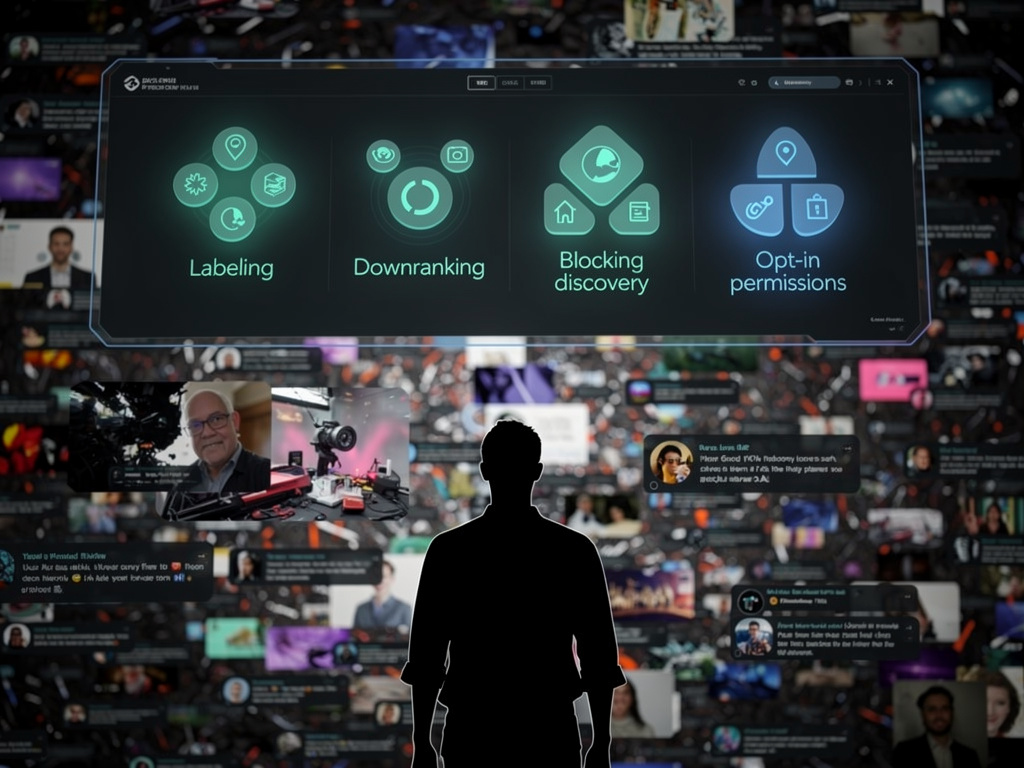
That is why I think a lot of this backlash will end up looking less like ethics messaging and more like boring ranking changes. Labels. Downranking. Discovery exclusions. Better reporting categories. Stricter defaults on sensitive generation. Less automatic boosting for synthetic sameness. More friction before a model can remix a real person's face or place a fake scene on top of a real location.
Not glamorous. Necessary.
The smartest AI products are going to get quieter
There is a funny inversion happening here.
For the last two years, product teams acted like the winning move was making AI louder. Bigger buttons. More summaries. More generated media. More surfaces where the model can jump in and remind you it exists. That worked great for demos and investor decks. It worked a lot less well for daily life.
The next wave of winning products will probably do the opposite. They will hide the model better. They will use AI where it reduces friction instead of creating it. They will make opt-in matter. They will treat sensitive identity features like explosives instead of engagement candy. They will be more careful about where synthetic content enters public ranking systems. And they will stop assuming that "generated" automatically means "good enough."
In other words, the smart teams are going to start shipping AI like infrastructure instead of spectacle.
That is a healthier direction. It is also a little embarrassing for the companies that spent the last year treating endless synthetic output as a growth hack.
Backlash is finally becoming product governance
This is the part I think people miss when they laugh off user anger as noise.
User disgust is governance when it lands hard enough.
You can see it already. The AI fight is moving from abstract arguments about the future to concrete fights over defaults, labels, ranking, consent, and removal. That is where power actually lives in consumer software. Not in keynote language. In whether a feature ships on by default. In whether a fake-looking post gets boosted or buried. In whether a person has to opt out of being synthetic raw material.
That is why this week matters. The big signal is not that AI got unpopular. The big signal is that platforms are being forced to admit popularity was never the same thing as permission.
If they are smart, they will learn from it fast. If they are not, users are going to keep yanking the rollback lever for them.